Step turning and taper turning are two critical lathe operations. Both are used in precision part machining. However, each processes shape cylindrical workpieces, but they serve different purposes and suit different design requirements. You must understand when to use each method. It helps you avoid wasted effort and improve component performance.
Step turning creates multiple diameter levels along the workpiece length. It is ideal when your part needs flat shoulders, seating areas, or mounting features. This method works best for shafts, bushings, or stepped pins where uniform changes in diameter are required.
Taper turning forms a gradual reduction or increase in diameter across a defined length. You can use it for parts like machine spindles, pipe joints, or mating fits. Usually, these parts rely on angle-based alignment. The method validates smooth transitions and increases mechanical fit where precision tapers are necessary.
In this guide, we will explain what step turning and taper turning are, how they are different, and the scenarios in which one should choose over the other.
What is Step Turning?
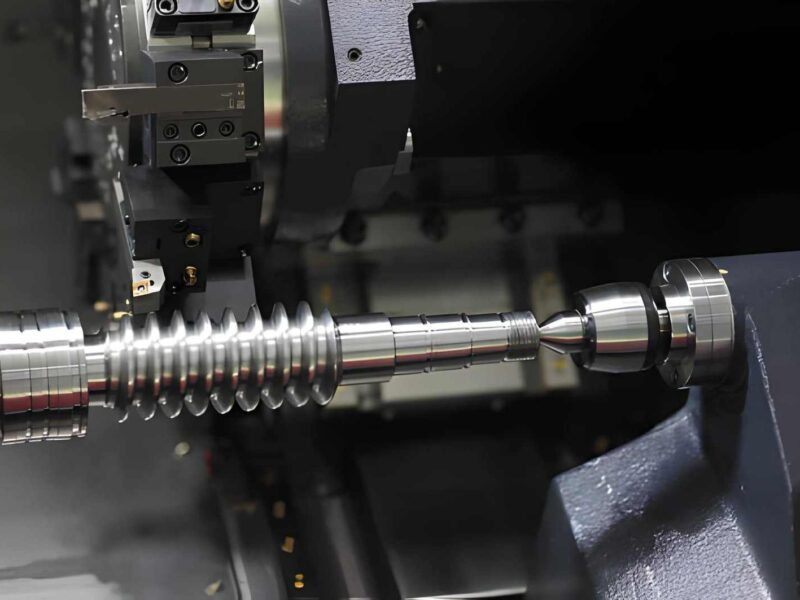
Step-turning is a widely used lathe operation. It forms a two-sectioned or more-sectioned cylindrical workpiece. Each segment, or “step,” is of varying diameter.
How It Works
- The workpiece is rotated against the cutting tool of the lathe.
- A cutting element translates in the direction of the axis.
- The device makes cuts at varying depths to create steps.
Every cut forms a step, useful for parts requiring different thicknesses and support at several points. It is particularly useful for shafts that house gears or bearings.
Why It is Used
- Reduce the weight of components without compromising strength.
- It lets the surface hold other parts.
- To accommodate a specific design and fit.
You’ll frequently see step-turned parts in:
- Automotive parts
- Drive shafts
- Structural connectors
What is Taper Turning?
Now, let’s explore the Taper Turing method. This process does not have a step-wise shape but one continuous conical form. One end of the workpiece is broader than the other as its diameter extends to a certain extent.
How It Works
- The tool travels at an angle to the workpiece axis.
- The taper ratio (say 1:10 or 1:20) is determined by the angle.
- The product is a cone that fits snugly into the associated elements.
Where It is Used
- To provide self-centering, tight fits.
- To reduce spinning weight, misalignment, or vibrations.
- For more evenly distributing the load between mated components.
Tapered CNC turning is extensively used in engines, lathes, machine tool spindles, and tool holders, as well as in precision ball screws.
Step Turning vs Taper Turning: What’s The Difference?
Though both processes use a lathe, their results couldn’t be more different. Here’s a comparison overview between step turning vs. taper turning.
| Feature | Step Turning | Taper Turning |
| Shape Outcome | Distinct cylindrical sections | Smooth cone-like shape |
| Tool Movement | Parallel to the workpiece axis | At an angle to the workpiece axis |
| Cutting Complexity | Low | Moderate to high |
| Surface Transition | Sharp between steps | Smooth, gradual transition |
| Typical Use Cases | Shafts, gear supports, attachments | Tapered joints, sleeves |
| Setup Time | Short | Slightly longer |
| Fitment Accuracy | Moderate | High |
So, which one should you pick? It entirely depends on the actual product application. If your part needs varying diameters with sharp shoulders, go for step turning. If it must fit perfectly with another part, taper turning is the way to go.
Types of Turning in CNC Machining
There are various types of Turing Operations. All these methods serve a unique purpose: they all help form your product with accuracy and in an economical manner. Whether you’re developing a functional prototype or gearing up for high-volume production, choosing the appropriate operation is imperative.
At Premium Parts, we provide comprehensive CNC turning services. We employ state-of-the-art CNC machines and lathe cutting tools. Here are the common types of turning we do:
Straight Turning
In straight turning, the material is removed over the length of the workpiece to achieve a smooth, uniform diameter. It’s great when you want a uniform cross-section.
Grooving
Grooving cuts long, narrow, recessed slots into the workpiece. The retaining rings, the O-rings, or similar snap-fit features are frequently accommodated in these grooves. We comprise tools to shape narrow tolerances and clean finishes.
Thread Cutting
We make internal and external screw threads with a thread-cutting tool for a lathe. Those threads need to be accurate for tight sealing and easy assembly.
Boring
Boring machining extends an existing hole with high precision. It’s ideal for loosening up fitment or readying a part for press fit and bearings.
Parting
Parting is also referred to as cut-off work. It takes sharp tools and good control, or you risk burning the edges or the surface.
Selecting the appropriate Turning Tool
All precise parts begin with the right tool. The geometry, the material, and the cutting angle all count when it comes to maintaining high precision and accuracy. The tool, among other problems, could result in bad finishes, inaccuracy, and even tool breakage.
Here’s how we break it down:
| Tool Type | Purpose |
| Roughing Tool | Cuts a lot of material |
| Finishing Tool | Provides an even, uniform surface |
| Grooving Tool | Cuts thin, precise channels |
| Thread Cutting Tool | Makes threads with clean starts and stops |
| Form Tool | Completes complex shapes, profiles, and contours |
For step turning or taper turning, our technical team chooses tools depending upon speed, feed rate, material, and component geometry.
Applications of Step Turning
- Multi-bearing zone transmission shafts
- Valve sticks with a sealing and guiding diameter separate
- Shouldered gear hubs for precise alignment of gears
- Electric motor rotors provide incremental support for the interior windings
Step turning is commonly used in industries such as automotive and aerospace, where the interchangeability of parts is essential.
Applications of Taper Turning
Taper turning is harder but needed when the diameter changes slowly. A slight error in the taper angle may result in assembly issues. That’s why there is no room for error here.
Typical use cases include:
- Lathe spindles designed for Morse tapers
- Tool holders that require precise alignment
- Taper pins and matching taper sleeves for accurate locating or fastening
- Liquid-tight angled joints used in hydraulic couplings
These components are usually used under heavy loads. So, they require strict axial alignment. And that’s what we’re best at: providing tapered parts with tight tolerances using CNC turning services.
How to Choose Between Step Vs. Taper Turning? Practical Considerations
Here are the common factors to consider before making a choice.
1. Function of the Part
Does the component need to meet closely and firm connection, or will it be used as a shelving support? If so, you’ve probably already got your answer.
- Use step turning to machine shoulders and achieve precise step diameters.
- Use taper turning to produce smooth, uniform tapers for close-fitting components.
2. Tolerance Requirements
Conical components tend to require more precise dimensional control. CNC contributes to that, particularly in the case of our efficient CNC turning technology.
3. Assembly Needs
Tapered components generally demand the application of presses, clamps, or locks. Standard steps can be used to enable the build-up of step parts.
4. Cost and Efficiency
Step turning is faster and simpler. Taper turning is more of a pain to set up, but lends itself to perfect fitment. At Premium Parts, we customize tool paths and machine parameters for each job to reduce lead times and ensure quality.
Get Superior Turned Parts from Premium Parts
At Premium Parts, we don’t just cut parts; we build quality into every part. When it comes to step turning vs. taper turning, our policy is the same: absolutely no compromises to precision.
Here’s What Sets Us Apart:
- Design Team: For each turning stage requirement of the parts, our design engineers professionally design a CAD model, and we test a prototype before initiating the actual production runs.
- Custom Tooling: We have expert lathe cutters and custom tools for every project.
- Smart Production: We manufacture small to large volumes of high-precision parts using our precision CNC turning machines.
- Material Capabilities: From aluminum and stainless steel, we have experience with a variety of metals and plastics.
- Quality Checks: Dimensional checks, surface finish, and material integrity are checked here to ensure everything is of the high quality we expect!
If you need custom threads? We will take a suitable thread-cutting tool for the lathe and check the thread depth and pitch for every part. If you need parts with minimal turnaround? We optimize our CNC setups for speed with no compromises on standard quality.
Step Turning vs. Taper Turning: Which One Suits Your Work?
There’s no universal answer. That will depend on your project, what material you’re using, and what performance you expect. Here’s a quick cheat sheet:
| Situation | Best Option |
| Several diameter regions are targeted | Step Turning |
| The part has to fit in a conical hole | Taper Turning |
| Cost-sensitive prototyping | Step Turning |
| High-performance fitment | Taper Turning |
| The requirement for easy part transitions | Step Turning |
| Smooth force distribution is necessary | Taper Turning |
Still not sure which method is right for you? Our engineers would be pleased to advise. You can send us your design, and we will suggest the best method of machining as per your project requirements.
Ready for Your Next Turning Project?
You shouldn’t have to slow down when choosing between step turning and taper turning. With Premium Parts, we’ll walk you through the process, from initial design consultation to production and delivery.
Let our team handle the details, and you can.
- Request a Quote Today
- Chat with Our Engineers
- Get quality turned parts fast
Learn more about the pinpointed accuracy of our turning services. Find out how our precision-based CNC turning can enhance your project’s performance, durability, and turnaround time.
Final Thoughts
Every cut counts in the age of CNC machining. Step turning vs. taper turning isn’t just about shape, however; it’s about securing the performance, fit, and durability your part deserves.
Weighing the pros and cons of each approach and choosing the right one can make sure your design works exactly the way it should.
At Premium Parts, our expert CNC turning services deliver high-precision parts with exceptional quality. From a single prototype to full-scale production, we handle every project with precision and reliability. Contact us today, and get an instant free quote!
FAQs
Q1: Can both techniques be applied to the same part?
Yes, it is possible. Some parts may require stepped diameters, and others need a taper. Our machines are a new generation. So, we can accommodate intricate hybrid shapes in one setup.
Q2: Which process is faster, step turning vs taper turning?
In general, step turns are usually faster. It includes fewer angle checks and fewer tool movements. Ultimately, the choice between them is based on the geometry and selected material for machining.
Q3: What measures can be taken to ensure frame taper accuracy of CNC turning?
Our Engineers are applying digital angle offsets and live tooling compensations. These are paired with real-time feedback systems. This allows us to expertly control the taper on every part made.
Q4: What if a job requires a turning tool for both step and taper shapes??
No problem. We carry various types of turning tools. Our tooling adapts to changes automatically for such challenging jobs.
Q5: Does Premium Parts produce the turning machines?
No, we aren’t producing machines. We specialize in CNC component production with state-of-the-art equipment and technology for custom parts.
Q6: What are the typical applications for taper-turned components?
You can find them in the aerospace, medical, automotive, and tooling industries, wherever a precise fit and rotational symmetry are critical.
Q7: Can you surface finish after turning?
Yes. We provide surface treatments such as
- Anodizing
- Powder
- Coating
- Polishing, and many more.
Appearance and function can both benefit from a fine form.