Many manufacturers use the terms CNC lathe and CNC turning center interchangeably, but they are not the same machine. While both perform turning operations, their capabilities, tooling options, and production applications can differ significantly.
Choosing the right equipment affects machining strategy, production cost, lead time, and the number of operations required to complete a part. A simple shaft may be efficiently produced on a CNC lathe, whereas components with milled features, cross-holes, grooves, and multiple machining operations often benefit from a CNC turning center.
This guide explains the key differences between CNC lathes and CNC turning centers, including their capabilities, applications, advantages, and the factors manufacturers consider when selecting the most suitable solution for a project.
What Is a CNC Lathe?
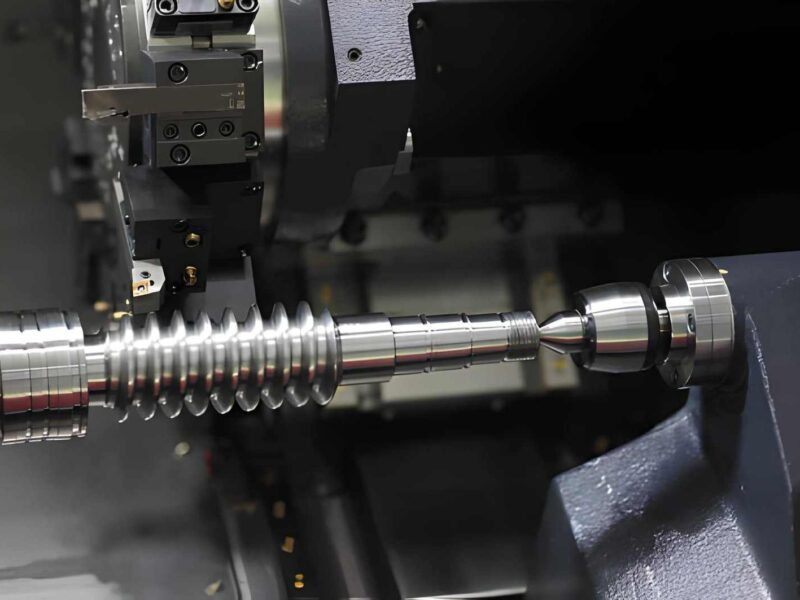
A CNC lathe is designed for cutting cylindrical parts by using only 2 axes. The part turns, and the cutting tool moves across both the X and Z axes to cut off material. A CNC lathe machine is suitable for making grooves, threads, and facing parts in basic turning.
Manufacturers typically use CNC lathes for simple turned components with rotationally symmetrical geometries.
- Produces parts such as shafts, bushings, pins, sleeves, and rollers.
- Supports straightforward turning operations with minimal setup complexity.
- Requires shorter programming and setup times for basic part designs.
No matter if you are using a CNC metal lathe or a CNC wood lathe, simplicity and speed set this technology apart.
Types of CNC Lathe
Several types of CNC lathes meet unique demands in engineering and production.
- Two-Axis CNC Lathe: Two-axis CNC lathes have the standard control features. These operations are in the X and Z axes. They are used for basic turning, facing, and boring tasks.
- CNC Metal Lathe: A metal lathe machine is ideal for shaping materials like aluminum, steel, and titanium. CNC metal lathes stand out with their sturdiness, cutting ability, and accuracy.
- CNC Wood Lathe: These machines are used in prototyping and work well with soft materials.
- Slant Bed Lathe: These machines carry an angled bed that makes it simpler for chips to exit and for stabilized cutting. Manufacturers use these for fast and efficient activities.
- Flat Bed Lathe: They are common for large items since their flat shape makes room for them and gives enough space for machining.
Advantages of CNC Lathe Machining
Many manufacturing shops employ CNC lathes because they are simple and perform well during production. Here are some of the common reasons that make it reliable and adaptable:
- High Setup Programming: These machines get set up fast. So, they’re perfect for manufacturing when time is critical.
- High Precision for Cylindrical Parts: A CNC lathe can produce cylindrical parts with near-closed dimensions.
- Cost-Effective for Simple Jobs: Lower machine costs and fewer features make them affordable for basic tasks.
- Low Maintenance Requirements: Because of fewer moving parts on CNC lathes, these machines require less upkeep.
- Excellent for Repetitive Work: Lathe machines are ideal for tasks that demand repeated shapes or consistent geometry.
What is a CNC Turning Center?
A CNC turning center machine features additional axes. You can say it’s an improved version compared to a standard CNC lathe machine. Among its options are live tooling, sub-spindles, and Y and C axes for more complex parts machining. Choosing the right machining can do both turning and milling in a single cycle.
Manufacturers typically choose CNC turning centers for parts that require multiple machining operations within a single setup.
- Supports live tooling for milling, drilling, and tapping operations.
- Allows machining from multiple sides without repeated repositioning.
- Handles complex part geometries with fewer secondary operations.
- Twin-spindle configurations can automatically transfer parts between spindles for complete machining.
You can expect standard quality, complex shapes, and high demands to be achievable because our company uses CNC turning and milling centers to finish all in one setup.
Types of CNC Turning Centers
CNC turning centers are meant for working on rigid and complex tasks. Here are the common types of turning centers:
- 3-Axis Turning Centers: 3-Axis turning centers can create slots and holes during the turning procedure through live tools.
- 4-Axis Turning Centers: Having an extra Y-axis makes 4-Axis turning centers perfect for creating complex shape components.
- CNC Vertical Turning Center: They are made to work vertically. These focus on heavy or big pieces and provide good chip management.
- CNC Mill-Turn Centers: These mill-turn centers combine all the steps of milling for one finished part.
- Dual Spindle Turning Centers: Integrating two spindles, these machines can accommodate both ends of the part without adjustments in the setup.
Advantages of CNC Turning Centers
With a CNC turning center, you can achieve high precision and accuracy in parts. Let’s talk about the reasons why engineers depend on them.
- Single Setup Operations: They are able to finish several steps while the part remains in one machine.
- Live Tooling Support: It is possible to do milling, drilling, and turning without stopping the machine.
- Managing Complex Parts: These machines can precisely shape rough parts with relative ease.
- Improved Accuracy and Speed: It is less likely that errors will appear, and the work is completed in a minimal amount of time.
- High Throughput: These are perfect for producing several precision parts with a lot of needed features.
CNC Lathe vs CNC Turning Center
| Feature | CNC Lathe | CNC Turning Center |
| Axes | 2 (X, Z) | 3-5 (X, Z, Y, C, and optionally B) |
| Tool Type | Fixed, single-use tools | Live tooling, tool changers |
| Operations | Turning only | Turning + Milling + Drilling |
| Spindles | One | The machine has one spindle or more than one in parallel |
| Part Complexity | Basic cylindrical parts | Complex multi-feature parts |
| Operator Involvement | Higher | Minimal |
| Setup Time | Fast | Longer but more automated |
| Suitable Batch Size | Small to medium | Medium to high |
Differences Between CNC Lathe and CNC Turning Center
Here are the common differences between a CNC lathe Vs CNC turning center. Let’s have a look at them:
Axis Capabilities
One major difference between the two is how the machining axis is controlled. CNC lathes work with the X and Z axes. It is the right suit for cylindrical or conical shapes. Nonetheless, turning centers have a Y-axis for off-center work and a C-axis used to mark set rotational positions.
This means:
- Through turning centers, you can create complicated shapes in a single pass.
- Manufacturers who work with lathes frequently use different setups and machines.
If your parts have angled holes or off-center milling, a CNC turning center can be a go-to choice.
Tooling Differences
Standard lathes consist of stationary tools fixed on a turret. Machines that carry out slotting or drilling are typically not part of the main operations. Also, parts are brought to them after the main machining steps are completed.
That issue can be avoided when the equipment includes live tooling. These types of tools can:
- Bore axial and radial holes.
- Be sure to cut the flat surfaces and the grooves needed.
- Perform non-aggressive milling operations.
Spindle Configurations
Most of the CNC lathe machines entail a single spindle. When a part’s front side is machined, the operator manually moves it and holds it for further machining on the back side.
Automating this process is possible with the help of CNC turning centers that have sub-spindles. The main spindle works on one side and then instantly places the part in the secondary spindle to finish the task. This results in:
- Fewer errors
- Improved concentricity
- Reduced handling
Premium Parts speeds up and perfects its parts by integrating CNC turning with CNC milling centers.
Machining and How Flexible They Are
If you need parts that demand a uniform shape from each side with consistent dimensions, make use of a CNC lathe. When your component’s features include cross-holes or complex designs, it is better to select a CNC turning center machine.
Turning centers:
- Shorten the process time
- Can perform multiple operations together
- Get tighter control over both the fit and the parts’ appearance produced
Choosing the right solution depends more on speed, quality, and cost than just on how complex it is. This is where Premium Parts steps forward to help.
Applications for Different Industries
CNC lathe vs CNC turning centers bring unique benefits to various manufacturing sectors. These include
| Industry | CNC Lathe Applications | CNC Turning Center Applications |
| Aerospace | Shaft bushings, retainers | Brackets, valve bodies, and landing gear parts |
| Automotive | Axles, tie rods, fasteners | Differential housings, piston heads |
| Medical | Bone screws, surgical pins | Implants, surgical handles, dental fixtures. |
| Oil and Gas | Couplings, adaptors | Flow control devices, drilling connectors |
Should You Choose a CNC Metal Lathe over a Wood Lathe?
You might wonder about CNC wood lathes, whether they are the same as CNC metal lathes. Let’s break it down.
- Although wood lathes operate faster than others, they give less stability.
- Metal lathes provide extra torque and accuracy when making products.
- Our services rely on industrial CNC metal lathes for the production of parts that are strong and precise.
Vertical Turning Center: Another Advanced Option
In some cases, part geometry forces vertical machine placement. The spindle is placed vertically in a CNC vertical turning center so that gravity can help position large components.
Their advantages include:
- Setting up becomes easier when dealing with large-diameter products
- Good assistance while carrying out deep boring
- Better chip elimination
We use CNC vertical turning center machines to design parts with a diameter of 18in.
Choosing Between Using a CNC Lathe vs a CNC Turning Center
Go with the CNC lathe if:
- The part shape is simple
- Low to medium production demand is there
- You are more concerned with the cost than with automation
- Secondary operations are not critical
You can choose CNC turning centers if:
- The part includes several axes of movement.
- Setting up one tool.
- Samples’ consistency and tolerances play a vital role in the process.
- The batch size is several hours, or it happens over and over.
The difference between a CNC lathe and vs CNC turning center lies in striking the right balance between being complex and being efficient.
Partner with Premium Parts for Custom Machining Service
We specialize in parts, instead of selling complete machines. Every design idea is studied by our engineers, who choose the most suitable tooling approach and which tools to select. Our in-house facility is equipped with.
- Traditional 2-axis CNC lathe machines
- Multi-function CNC turning and milling centers
- Large-format CNC vertical turning centers
When you get Premium Parts, you can get several benefits.
- Complete design for manufacturing(DFM) support
- Fast delivery and global delivery
- Full information about where the materials come from
- We can adjust the tooling from prototype to mass production
- Affordable prices
Summing Up
Between the CNC lathe vs CNC turning center, the main factor lies in the actual part or product you are looking to accomplish. Basic lathes are made for handling quick jobs that don’t need much machining. Power, precision, and the ability to complete complex designs are reasons why turning centers are useful.
At Premium Parts, we make sure to choose the perfect machine each time for optimal results. We use the latest machines to deliver fast and dependable results for every project.
Do you have a part you want to work on? Send us your CAD drawing or file, and we will explain the best way from designing to completing your product.
FAQs
Q1. Is drilling holes possible with a CNC lathe machine?
Manufacturers use in-line milling when there is no live tooling present. Use a turning center when drilling holes, not in the workpiece center.
Q2. Is the higher cost of a CNC turning center worth it?
Yes, when the parts are complex need to be manufactured. Because of it, changing the setups becomes less frequent, and the parts machining becomes smoother.
Q3. What is a CNC mill-turn center?
It is a machine that joins turning and milling, and normally has multi-axis control.
Q5. Do CNC turning centers require a longer time to program?
Still, both the lower cycle time and using humans are better for the company’s return on investment in the long run.